
Bugis

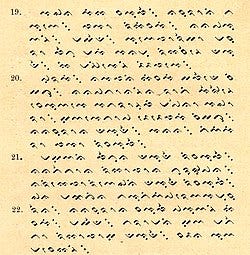
On the island of Sulawesi, Indonesia, the Bugis people developed a script that is as elegant as it is enduring. Known as Lontara (ᨒᨚᨈᨑ), the Bugis script is part of the larger family of Brahmic scripts that spread across South and Southeast Asia, adapted to local languages and cultures.
Origins and Form
The Bugis script is thought to have descended from Kawi, itself derived from the ancient Pallava script of southern India. By the 15th century, it had fully taken on its distinct identity. Written in neat, almost geometric shapes, Bugis letters are notable for their balanced curves and straight lines, giving them a compact and rhythmic appearance.
Like many Brahmic-derived systems, Bugis is an abugida: each symbol represents a consonant with an inherent vowel sound, and diacritic marks are added to alter that vowel. For example, the base consonant ka (ᨀ) can be modified with marks to produce ki, ku, ke, ko. Unlike some other Brahmic systems, though, Bugis does not mark final consonants, leaving readers to infer them from context.
Language and Literature
The script was traditionally used not only for Bugis but also for related languages such as Makassarese and Mandar. With it, the Bugis preserved a vast body of oral epics, genealogies, chronicles, and laws. Among the most famous is the La Galigo, one of the world’s longest literary works, a sprawling Bugis epic that rivals the Mahabharata in scale.
Materials and Everyday Use
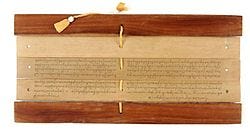
Traditionally, Bugis writing was carved or inked onto lontar palm leaves—hence the name Lontara. The neat and angular script lent itself well to inscribing on such surfaces. Beyond literature, it was also used in administration, trade, and religious contexts, making it central to Bugis cultural life.
Decline and Preservation
With the rise of the Latin alphabet during Dutch colonial rule, the use of Bugis script began to decline. Today, most Bugis people read and write in Indonesian using Latin script, though Lontara is still taught in some schools and remains visible on public signs, currency, and cultural documents in Sulawesi.
Modern digitization has also given the script a new lease on life: Bugis was added to Unicode in 2005, making it possible to type and display Lontara online. This digital preservation ensures that Bugis letters remain accessible in the 21st century, even as daily use fades.
Why Bugis Matters
The Bugis script is a window into Sulawesi’s rich intellectual and cultural history. More than just a tool for writing, it encodes identity, memory, and artistry. Its continued presence—whether in epic poetry or in a modern Unicode font—reminds us that scripts are not just symbols, but vessels of culture that carry voices across centuries.